
“Of the Importance of General Vaccination and the Groundlessness of the Prejudices Against It”
Sharon Folkenroth-Hess, M.A., Archivist
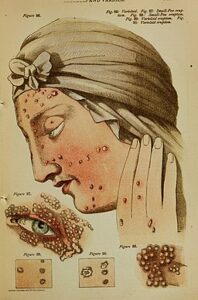
The 1870s and 1880s smallpox epidemics in the United States can be attributed to the successful mass vaccination efforts in the first part of the century. As cases became rare toward the mid-century, vaccine use decreased. Out of sight, out of mind. With the population susceptible to the ravages of the disease, physicians and governments pushed for a return to former immunization rates by enforcing existing mandates or creating new ones. The pushback was immediate. Inspired by their counterparts in Europe, anti-vaccination activists railed against the laws, citing concerns regarding the safety and efficacy of vaccinations and violations of their civil liberties (“Is Vaccination Dangerous?” 1879).
With smallpox cases on the rise, the Board of Health of the State of Delaware called upon Dr. John K. Kane, Jr, M.D., to address the public’s concerns. In addition to his position as president of the Delaware Medical Society, the Board likely selected Dr. Kane because of his minor celebrity and family name recognition. Dr. Kane’s 1882 report, “Vaccination. Of the Importance of General Vaccination and the Groundlessness of the Prejudices Against It,” was initially presented to the Board and was printed in the Wilmington newspaper, The News Journal (Kane, 1882). The Delaware Academy of Medicine Archives has an 1883 reprint of the report on display in the Lewis B. Flinn Library.
John K. Kane Jr. was born in Philadelphia in 1833. He attended the University of Pennsylvania and received his medical degree from Jefferson College. After passing an examination before the Naval Commission, he sailed on the polar expedition sent out in 1854 to search for his brother, Dr. Elisha Kent Kane. The expedition was successful, and Dr. John K. Kane accompanied his brother to Cuba, remaining with him until he died. He continued his medical studies in Paris and then returned to Philadelphia to practice. He served as an army surgeon in Cairo, Illinois, and Chester, Pennsylvania, during the American Civil War. In l868, he was appointed surgeon of the Philadelphia, Wilmington, and Baltimore Railroad Company. In 1879 Dr. Kane was elected president of the Delaware Medical Society. 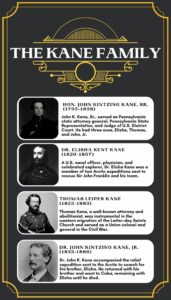
Late nineteenth-century immunizations involved more than the quick ‘shot’ we enjoy today. In a “vaccine operation,” a small spot on the patient’s upper arm is scored with a needle or lancet. Then a small amount of “lymph” containing live cowpox or vaccinia virus is applied to the wound. After a few days of mild discomfort, the lesion produced a blister-like vesicle. Once healed, a tell-tale cicatrix scar appeared and served as permanent proof of vaccination. Immunity would last between five to ten years if done correctly.
Before the mid-century, cowpox lymph was collected from an infant or young child. As demand for vaccines increased, health departments and entrepreneurs created stock farms to supply the cowpox virus in large quantities. Cowpox lymph was often harvested directly from cows and dried onto ivory points, injected into goose quills, or sold as scabs. Even though the city council elected official ‘vaccination doctors’ who were required to provide the service to all at low or no cost to the patient (“The Question of Vaccination,” 1881), vaccine points and quills were available from the corner druggist or apothecary. As Dr. Kane complains, these vaccines were not always reliable:
“The demand for [the vaccine] has become so great that, either the vendors, not content with the very great profit that must have accrued to them legitimately, have used a spurious imitation (nothing could be easier than to stain a quill or ivory point with mucilage or cochineal), or else that the retailers sell stale points which have become inert (Kane, 1882).”
Even if the vaccines were prepared correctly, transportation and storage conditions could significantly impact the product’s efficacy. Some of the vaccines would not produce a strong enough reaction in the patient to provide them with immunity. These faulty products helped to spread doubt regarding the protective power of immunization.
In 1881, the Board of Health and the city vaccination doctors unanimously resolved to discontinue the use of quills and points and rely on arm-to-arm transmission (“Down on Bovine Quills,” 1881). With this method, a physician would collect material directly from a human pustular cowpox lesion and immediately apply it to the prepared wound on the patient. In his report, Dr. Kane does not specify how the supplier of the lymph was selected, only that it be taken from “healthy children with well-formed vesicles” (Kane, 1882). However, during the vaccine physician’s caucus of 1892, Republican nominees argued that scabs should be used instead of fresh lymph and created turmoil within the city council (“Vaccine Physician Caucus,” 1892). The election of the vaccine physicians was a matter of politics rather than merit well into the twentieth century.
One primary objection to humanized lymph and scabs was that other communicable diseases like syphilis or scrofula would be transmitted in the humanized lymph. Dr. Kane scoffs at these ‘groundless’ fears, stating that it is impossible even accidentally to transmit disease this way (Kane, 1882). Although later disproved, he was not alone in this belief, and the practice continued for another two decades. Arm-to-arm transmissions were later banned after cases of hepatitis and syphilis were connected to smallpox inoculations.
Delaware concluded that the benefits of inoculation outweighed the risks. According to Dr. Kane, “those who die from Small-Pox the average is only 3 ½ to 4 per cent in the vaccinated, as contrasted with 30 to 50 per cent of those who were unprotected by vaccination” (Kane, 1882). On March 21, 1881, Delaware passed a law that required all children attending public schools to be vaccinated unless already protected from smallpox by vaccination or by an attack of smallpox (“School Children Must Be Vaccinated,” 1883).
It is difficult to overstate how vital smallpox inoculation and vaccination have been to the health and well-being of Delawareans and the world. Still, some efforts to promote these public health measures may have done more harm than good. The suspicions born in this period linger today.
References
Down on Bovine Quills. (1881, July 9). The Daily Gazette, 1.
An Important Move: School Children Must Be Vaccinated. (1883, October 9). The Daily Gazette, 1.
Is Vaccination Dangerous? (1879, May 18). The News Journal, 2.
Kane, J. K. (1882, June 15). Vaccination. Of the Importance of General Vaccination and the Groundlessness of the Prejudices Against It. The News Journal, 4.
One Democratic Vaccine Physician Elected. (1892, January 14). Delaware Gazette and State Journal, 1.
The Question of Vaccination. (1881, May 12). Daily Republican, 1.
Vaccination: How Wilmingtonians Have Taken The Ounce of Prevention. (1881, January 19). The Morning News, 1.
Vaccine Physician Caucus. (1892, January 1). The Evening Journal, 1.